

News and Trends
Pre-action Sprinkler System, A119-YW, Bandung
TL;DR: Wanlin Extends Freeze-Protected and Corrosion-Resistant Trim for Bandung Sites
Wanlin extends freeze-protected and corrosion-resistant trim for coastal and cold sites for Bandung and Indonesia housing associations, property managers, facility management groups, fire protection contractors, distributors and importers. A lithium-ion pack in a bike shelter does not wait: it vents, it ignites and it hands the fire to the next vehicle along the rack. The Wanlin shelter package is built for that timeline - an AI flame detection camera that identifies flame by spectral signature and flicker geometry instead of waiting for smoke to drift into a chamber, a wireless control module that opens the solenoid valve and starts the pump without a single metre of new cable, and rotating sprinkler heads covering roughly 20 m2 each that keep water on the fire long after the flames are gone. The WANLIN wireless device family - A119-YW Smoke Detector Tester and Test Kit among them - rides on the same host, adding detection, signalling, gas and charging-board monitoring where the layout calls for it. Every shipment leaves with hydraulic calculation, CE, RoHS and REACH files, EN 12845 and NFPA 13 design documentation, and a commissioning record from the Bandung test floor. OEM/ODM with private label, factory-direct export supply for Bandung and Indonesia.
Featured WANLIN device this report: A119-YW Smoke Detector Tester and Test Kit - Multi-stimulus tester configuration configuration — combined smoke and heat tester with a telescopic pole head for multi-sensor and multi-criteria devices, with optional Bluetooth logging of every pass or fail result; sensing and method Non-flammable HFC-free test aerosol with a defined optical density band, directed-air heat stimulus to 100 C with a controlled ramp, compatibility with photoelectric, ionization, multi-sensor and multi-criteria chambers; output and signalling Pass or fail indication on the head, audible and visual confirmation at the test point, optional Bluetooth or NFC tagged result written against the device ID; connectivity Bluetooth 5.0 link to the reporting app on the multi-stimulus configuration, USB or cloud export of the site test report, standalone operation with no network on the aerosol and heat configurations; mounting Handheld gun body with a 1.2 to 4.5 m telescopic pole and an articulating cup head, belt clip and a shoulder strap, pole sections that break down into a carry bag; ingress protection IP42 control housing, operating 0 to +45 C, 10-90 percent RH non-condensing, aerosol canister rated for storage to +50 C; enclosure ABS V-0 impact-resistant body with a glass-filled nylon pole, stainless cup spring, chemical-resistant gasket set on the cup rim; indication LED status for ready, stimulus and result, canister fill indicator, battery state indicator, audible confirmation tone at the head; extra features Residue-free and silicone-free aerosol for clean rooms, museums and healthcare estates, safety data sheet in the shipment file, cup sizes for 65 to 150 mm detector heads, site report generated per device; warranty and after-sales 2-year limited warranty on the tester body, 3-year canister shelf life, calibration certificate per aerosol lot, 30-day DOA replacement; in the box Tester body or gun, telescopic pole set, cup head assortment, aerosol canister, battery pack and charger, carry bag, calibration certificate, multi-language manual EN/AR/ES/FR/RU. Full component data sheet below.
Published by Wanlin Manufacturing Group (Wanlin Brand) | Last updated: September 18, 2026 | Expertise: 15+ years fire detection, suppression and instrumentation manufacturing and export
Dispatch note for Bandung: Indonesia-bound consignments leave Shenzhen via Tanjung Priok (Jakarta) for Java and the capital region, with Tanjung Perak (Surabaya) for East Java, Belawan for Sumatra and Makassar for the eastern islands, plus feeder trucking into Bandung, Semarang, Palembang, Balikpapan, Denpasar and Banjarmasin. Cameras, control modules, valve sets, pump sets, heads, pipework and the country documentation folder are consolidated at the factory before sailing; typical door-to-door lead time for Indonesia runs 21-28 days after the batch clears pre-shipment inspection - the window most contractors use to land the pipework and the commissioning inside the same programme.
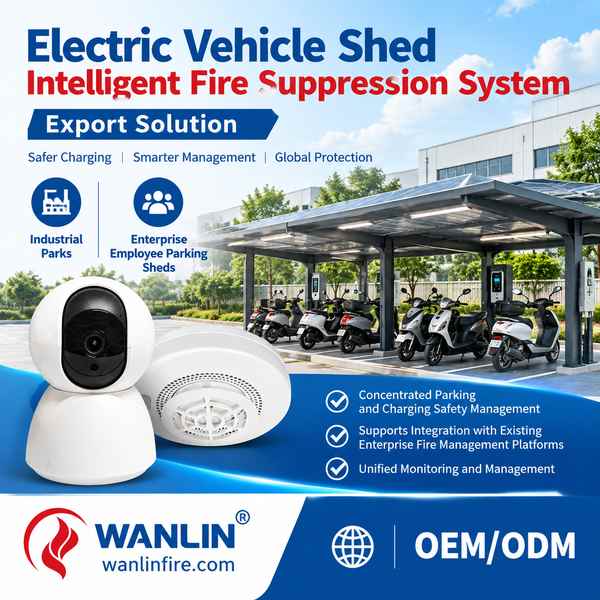
About Wanlin: Chinese E-Bike Shelter Fire Suppression Manufacturer and Export Supplier
Wanlin is the fire protection products brand of Wanlin Manufacturing Group, a 15-year Chinese manufacturer headquartered in Shenzhen, China. The brand builds the detection, control, pumping and discharge layer of a fire system - the cameras that see the flame, the modules that decide, the pumps and valves that move the water, and the heads that put it on the fire - for fire protection contractors, system integrators, housing associations, property and facility management groups, electrical wholesalers, civil defence contractors and their distributors across Bandung, Indonesia and more than 60 export markets.
Wanlin operates a genuine source factory with in-house injection molding, SMT PCB assembly, detector chamber calibration tunnels, pump and valve test benches, a sprinkler distribution collection grid, panel burn-in racks, pressure and level calibration benches and environmental chambers for cold soak and salt-spray cycling. Our factory builds the full shelter suppression line and the WANLIN device family around it - all configurations supported by CE marking under the Construction Products Regulation, EN 12845 design and installation reference, the EN 54 series for detection and control, NFPA 13, NFPA 72 and NFPA 855 documentation for the Americas, IEC 60364-7-722 and IEC 61851 wiring reference for charging positions, UKCA for Great Britain, RoHS and REACH files, EAC for the Eurasian customs union, RCM for Australia and New Zealand, SASO and SABER support for Saudi Arabia, ISO 9001 and ISO 14001 quality systems, hydraulic calculation and as-built documentation issued per project, custom colour and logo programs, private-label packaging, multi-language manuals (English / Arabic / Russian / Spanish / French / Portuguese / Indonesian / Urdu / Hindi / Vietnamese / Thai), and spares and consumables programs sized to each partner's annual project volume.
Inside the Wanlin E-Bike Shelter Suppression System: Flame Detection Camera, Wireless Control Module, Solenoid Valve, Pump and Rotating Sprinkler
The logic is deliberately simple: do not wait for the fire to arrive at the device, go and find it. A hanging extinguishing ball only works when the flame reaches its shell, which in an open-sided shelter is already too late. The Wanlin package moves the decision to the camera, moves the command over a radio link, and keeps the water running after the flame is knocked down - the part that stops the second and third battery in the rack. The table below is the chain, in the order a Bandung installer commissions it.
| Stage | What it does on a Bandung shelter | Field data from the Bandung programme |
|---|---|---|
| Flame detection camera | AI video analytics identify flame by spectral signature and flicker geometry, not by smoke or heat at a point; the camera scans the whole parking bay and triggers on an open flame at range, including a flame shielded behind a parked scooter | Trip within seconds of flame presentation at the declared range; welding arcs, headlamp sweeps and sunlit reflectors logged as rejection cases rather than alarms |
| Wireless control module | Receives the camera command and drives two outputs at once: opens the solenoid valve and starts the pump. No cable run between the camera, the valve and the plant room, which is what makes an occupied shelter retrofit viable | Command latency and supervision heartbeat logged at the worst-case position through masonry, roller shutters and plant rooms; battery and solar variants hold the same link budget |
| Solenoid valve | Normally-closed valve in stainless steel or brass holds the supply back until commanded, then opens to feed the shelter main; manual override and position feedback for the commissioning record | Valve-open confirmation within the declared window on all ten consecutive starts; dry-run protection and jockey pump cut-in exercised between starts |
| Pump set and water supply | Electric or diesel pump set with jockey pump, fed from the mains where pressure allows or from a tank and booster set where it does not; dry pipe and pre-action arrangements for unheated shelters and freeze-protected pump houses for cold climates | Pump-run confirmation and discharge at the furthest head within the declared time; tank volume and duration sized by hydraulic calculation rather than by rule of thumb |
| Rotating sprinkler head | Open rotating head discharging a moving water pattern across its design area, one head covering roughly 20 m2 of shelter floor - so a standard 60 m2 shelter is covered by about 3 heads rather than a forest of pipework | Collected density measured on a water collection grid at both design and minimum supply pressure; wetted footprint and uniformity within the declared tolerance |
| Continuous discharge | The pump keeps running for the design duration after the flame is out, cooling the failed cell and the packs either side of it so the row does not go | Thirty-minute hold with cell surface temperature logged: no re-ignition and no propagation to the adjacent position |
| Monitoring and alerting | Cloud dashboard and app push the alarm with a camera snapshot, plus valve state, pump state, tank level and riser pressure; the duty manager sees it on a phone in the same minute the water starts | Alarm, low-level and low-pressure events reached the dashboard and the app within the declared interval on every test |
| WANLIN device layer | Where the shelter is enclosed, in a basement or abuts a building, the WANLIN detector, call point, sounder, gas and instrumentation family joins the same wireless host as a second stimulus; on the charging board the WANLIN-705 monitor and WANLIN-710 breaker cut the faulting circuit before a cell ever reaches thermal runaway | A119-YW Smoke Detector Tester and Test Kit commissioned on the Bandung programme with the same host, the same event log and the same spares list as the suppression package |
How the two detection philosophies divide the work: in an open-sided shelter the flame camera and the heat channel carry detection, because moving air and dust make a smoke chamber unreliable. In an enclosed bike room, a basement store or a charging cabinet, the WANLIN detector family earns its place again and adds a second stimulus at very low cost. Wanlin does not sell one against the other - the same host runs both, and the commissioning record shows which device did what.
A119-YW Technical Specifications
| Parameter | A119-YW Smoke Detector Tester and Test Kit | Typical Import Unit |
|---|---|---|
| Role in the Shelter Package | Multi-stimulus tester configuration configuration — combined smoke and heat tester with a telescopic pole head for multi-sensor and multi-criteria devices, with optional Bluetooth logging of every pass or fail result | Single device with no integration path into the suppression system |
| Sensing Element / Detection Method | Non-flammable HFC-free test aerosol with a defined optical density band, directed-air heat stimulus to 100 C with a controlled ramp, compatibility with photoelectric, ionization, multi-sensor and multi-criteria chambers | Uncalibrated element, no method documentation |
| Output and Signalling | Pass or fail indication on the head, audible and visual confirmation at the test point, optional Bluetooth or NFC tagged result written against the device ID | Basic contact only, no diagnostics |
| Connectivity and Protocol | Bluetooth 5.0 link to the reporting app on the multi-stimulus configuration, USB or cloud export of the site test report, standalone operation with no network on the aerosol and heat configurations | No protocol, no telemetry, no BMS path |
| Mounting and Installation | Handheld gun body with a 1.2 to 4.5 m telescopic pole and an articulating cup head, belt clip and a shoulder strap, pole sections that break down into a carry bag | Proprietary fitting, extra adaptors on site |
| Ingress Protection | IP42 control housing, operating 0 to +45 C, 10-90 percent RH non-condensing, aerosol canister rated for storage to +50 C | Unrated enclosure, indoor only |
| Enclosure and Material | ABS V-0 impact-resistant body with a glass-filled nylon pole, stainless cup spring, chemical-resistant gasket set on the cup rim | Recycled plastic, unknown flame rating |
| Indication and Interface | LED status for ready, stimulus and result, canister fill indicator, battery state indicator, audible confirmation tone at the head | Single LED, no test or hush control |
| Extra Features | Residue-free and silicone-free aerosol for clean rooms, museums and healthcare estates, safety data sheet in the shipment file, cup sizes for 65 to 150 mm detector heads, site report generated per device | None |
| Certification and Compliance | CE marking under the Construction Products Regulation with EN 12845 (automatic sprinkler systems: design, installation and maintenance), the EN 12259 series for sprinkler components, EN 54-2 and EN 54-4 control and indicating equipment, EN 54-7 and EN 54-5 detection, EN 54-25 radio-linked components, EN 671 hose reels and BS 5306 as the portable and fixed-system reference, NFPA 13, NFPA 72 and NFPA 855 documentation for the Americas, IEC 60364-7-722 and IEC 61851 wiring reference for e-bike and e-scooter charging positions, RoHS and REACH files, UKCA for Great Britain, EAC for the Eurasian customs union, RCM for Australia and New Zealand, SASO and SABER support for Saudi Arabia, ISO 9001 and ISO 14001 factory systems, hydraulic calculation and as-built documentation issued per project, OEM/ODM and private label | Incomplete or missing |
| Warranty and After-Sales | 2-year limited warranty on the tester body, 3-year canister shelf life, calibration certificate per aerosol lot, 30-day DOA replacement | No spares path, no documentation support |
| Ships in the Box | Tester body or gun, telescopic pole set, cup head assortment, aerosol canister, battery pack and charger, carry bag, calibration certificate, multi-language manual EN/AR/ES/FR/RU | Unit only, no fixings or documentation |
Supply terms: Factory-direct pricing | OEM/ODM and private label | Shelter kits packed by phase or by site | Hydraulic calculation, CE, RoHS, REACH, EN 12845 and NFPA 13 documentation with every order | Custom colours, logo printing and carton branding | Spares and consumables programs sized to your annual volume | Sea freight via Tanjung Priok (Jakarta) for Java and the capital region, with Tanjung Perak (Surabaya) for East Java, Belawan for Sumatra and Makassar for the eastern islands, plus feeder trucking into Bandung, Semarang, Palembang, Balikpapan, Denpasar and Banjarmasin, plus air options for urgent project top-ups | Warranty and after-sales spare parts program.
Featured system profile this report - Open-Sided Shelter Profile (Camera + Pump + Rotating Sprinkler): the configuration most Bandung housing associations and property managers start with: one or two AI flame detection cameras scanning the parking bays, a wireless control module that opens the solenoid valve and starts the pump without a cable run, and rotating sprinkler heads covering 20 m2 each off a mains or tank-fed supply Open-sided shelters are exactly where a smoke detector and a hanging ball both fail - the air moves, the dust moves and the fire starts under a seat. The camera does not smell the fire, it sees it, and the pump keeps running after the flames are knocked down, which is the part that stops the second and third battery going.
Why Hanging Fire Extinguishing Balls Fall Short in E-Bike Shelters
Dry-powder extinguishing balls are cheap, they are easy to hang and they are on a lot of existing shelter drawings. They are also the device most Bandung specifiers are now removing, for reasons that have nothing to do with price. A ball is a passive device: the fire has to find it. The table below is the comparison our export desk walks Bandung partners through before a scheme is re-scoped.
| Question | Hanging extinguishing ball | Wanlin camera + pump + sprinkler package |
|---|---|---|
| What triggers it | The shell has to be touched by flame. A fire starting under a seat, inside a battery box or two bays away is not detected at all until the flame arrives at the ball | The camera identifies flame by spectral signature and flicker geometry across the whole bay and triggers at range, before the fire reaches any fixed point |
| How much it covers | Roughly one to two metres of radius, so the mid-bay position is frequently uncovered and the end-bay ball is frequently wasted | About 20 m2 per rotating head, laid out on a grid from the shelter footprint so coverage is drawn rather than guessed |
| What happens to the agent | Dry powder discharges in one burst and is then blown away by the same draught that made the smoke detector unreliable | Water is discharged continuously for the design duration, reaching the fire and the vehicles either side of it |
| Lithium battery behaviour | Powder knocks the visible flame down but does not cool the cell, so re-ignition is common and the next pack in the rack goes | Continuous water cools the failed cell and its neighbours; the thirty-minute hold on the Bandung rig logged no re-ignition and no propagation |
| How many times it works | Once. After the burst the device is spent, whether the fire is out or not | As many times as there is water and power, with the pump staying on the fire and the tank level and riser pressure reported to the dashboard |
| How you know it still works | Check the gauge and replace on the expiry date; testing it means destroying it | Quarterly trip test at the valve, supervision heartbeat on the radio link, tank level and pressure telemetry, and a camera snapshot with every event |
| Ten-year cost | Replacement cycles every few years across every hanging position, plus the call-outs for the fires it did not catch | One installation with a spares programme sized to the estate, and a commissioning record that insurers accept |
In one line: a ball is the fire finding the device. A camera, a radio link, a pump and a head on a grid is the system finding the fire - and then staying with it.
Competitive Comparison: Wanlin vs Other E-Bike Shelter Fire Suppression Suppliers
| Supplier type | Advantages | Disadvantages |
|---|---|---|
| Wanlin (Factory Direct) | 15-year manufacturer; the camera, control module, valve, pump set, head and pipework are supplied as one engineered package with the hydraulic calculation issued per project; the WANLIN device family integrates on the same wireless host; CE, RoHS, REACH, EN 12845 and NFPA 13 documentation with every shipment; OEM from low four-figure unit quantities; custom colours, logo printing and carton branding; 30-50 percent below brand-equivalent pricing | Newer brand recognition in markets where consultants were trained on the incumbent European and North American sprinkler houses |
| Incumbent Global Sprinkler and Fire Alarm Brands | Decades of specifier familiarity, deep standards-body relationships, established distributor networks | Premium pricing across the catalogue, closed protocols that lock the service contract to the brand, long quoting cycles and limited private-label or custom programmes - which is exactly why Indonesia distributors benchmark the Wanlin shelter package against them |
| Local Resellers and Importers | Fast delivery from local stock, on-the-ground support, familiar invoicing | No factory test data, no hydraulic calculation, no pump curve, no consolidated compliance pack, no spares programme, quality variance between lots, no OEM path for their own brand |
| Generic Wholesale Spot Buys (marketplace-style) | Lowest unit price on single-carton orders | No EN 12845 or CE file, no declared coverage, unrated enclosures, no pump duty point, no warranty service, no spares - a head that does not discharge at the design pressure costs the whole commissioning window |
Sizing and Deployment Guide: Cameras, Sprinkler Heads, Pump Sets and Water Supply for Bandung Shelters
Sizing is where most shelter schemes are won or lost, and it is the question the Bandung export desk answers first: how many cameras, how many heads, how much water and for how long. The camera count follows the layout and the sightlines, the head count follows the floor area at roughly 20 m2 per rotating head, and the pump and tank follow the resulting flow and duration. The reference table below is the starting schedule we issue before a site survey.
| Shelter size | Flame detection cameras | Rotating sprinkler heads | Indicative flow and pump duty | Water supply |
|---|---|---|---|---|
| Up to 50 m2 (small residential store) | 1 | 3 | About 180 L/min at the design pressure, single electric pump with jockey | Mains where pressure allows, or a 6 m3 break tank with booster |
| 50 to 100 m2 (standard terrace or block store) | 1 to 2 | 5 to 6 | About 360 L/min, electric pump set with jockey pump and automatic changeover | Mains plus a 6 to 10 m3 stored reserve for the design duration |
| 100 to 200 m2 (communal shelter or campus bay) | 2 | 8 to 10 | About 600 L/min, electric pump with diesel or battery standby | 15 to 25 m3 tank and booster set, freeze-protected in cold climates |
| 200 to 400 m2 (multi-bay staff or fleet shelter) | 3 to 4 | 12 to 20 | About 1200 L/min, duty and standby pump set with jockey | 30 to 50 m3 tank, dedicated pump house, riser pressure and tank level telemetry |
| 400 to 800 m2 (centralised hub or logistics depot) | 5 to 8 with overlapping fields of view | 24 to 40 in zoned groups | Zoned calculation, duty and standby pumps sized per worst-case zone | Twin tank or town main with monitored reserve, zoned valve sets, BMS interface |
| Retrofit of an occupied shelter (any size) | 1 to 2 per bay group | Existing grid retained where possible | Booster set sized to the existing pipework | Wireless modules remove the trenching; no floor reinstatement, no closing of the store |
Worked example for a 60 m2 Bandung shelter: about 1 flame detection camera(s) covering the parking bays, about 3 rotating sprinkler heads on a drawn grid, an indicative discharge around 210 L/min and a stored volume of roughly 6 m3 behind a 30-minute design duration. Those are indicative figures for budget purposes - the issued hydraulic calculation, pump curve and tank sizing follow the site survey and the local design density, and they are the numbers that go into the submission pack.
Inside the Compliance Stack: EN 12845, NFPA 13, NFPA 72, IEC 60364-7-722 and Local E-Bike Charging Rules
A shelter scheme is approved on paper before it is approved on site. The submission has to show the design standard, the design density and duration, the water supply, the detection and alarm arrangement, and - increasingly - the charging installation itself. The table below is the stack the Bandung documentation pack is built around; the certificate set, the hydraulic calculation and the manual in the language the inspector reads ship inside the shipment folder.
| Standard / approval | Status on the Wanlin shelter package | What it enables for Bandung buyers |
|---|---|---|
| EN 12845 fixed firefighting systems | Sprinkler design, installation and maintenance reference with the hydraulic calculation, design density, duration and water supply figures issued per project | A European submission that an insurer and an approving body can read without a follow-up query - the density and duration are on the drawing, not in a marketing sheet |
| NFPA 13, NFPA 72 and NFPA 855 | Sprinkler installation, fire alarm and signalling, and stationary energy storage documentation for the Americas, with the UL project path where the authority having jurisdiction requires it | US and Canadian buyers get the document set their AHJ and their insurer already read, which shortens the review rather than restarting it |
| EN 54 series detection and control | EN 54-7 and EN 54-5 detection, EN 54-11 call points, EN 54-3 and EN 54-23 sounders and visual alarm devices, EN 54-25 radio-linked components, EN 54-2 and EN 54-4 control and indicating equipment | The WANLIN device layer on the same host as the suppression system, under one certificate set rather than two parallel files |
| IEC 60364-7-722 and IEC 61851 | Wiring reference for e-bike and e-scooter charging positions: circuit partitions, RCD selection, socket-outlet and connector requirements | The charging board and the suppression system are designed together, which is what a modern bike storage code asks for |
| CE, UKCA, RoHS, REACH and the national marks | CE marking under the Construction Products Regulation, UKCA for Great Britain, RoHS and REACH files, EAC for the Eurasian customs union, RCM for Australia and New Zealand, SASO and SABER support for Saudi Arabia | The consignment clears at the port on first presentation instead of waiting on a broker's argument |
| Fire risk assessment and insurance evidence | Commissioning record with camera trip times, valve-open and pump-start times, discharge at the furthest head, tank level and riser pressure telemetry, and a quarterly test procedure | The annual review is a report rather than a walkaround, which is what a housing association and its insurer both want |
| Factory quality systems | ISO 9001 and ISO 14001, pump and valve test benches, sprinkler distribution collection grid, cold soak and salt-spray cycling, calibration records issued per lot | Documented, per-serial evidence for lenders, insurers and public procurement reviews |
Global E-Bike and Lithium Battery Fire Safety Market Trends
The London Fire Brigade has recorded year-on-year increases in fires involving e-bikes, e-scooters and their lithium-ion batteries and has run public campaigns on charging, storage and the use of approved conversion kits - the operational backdrop behind the bike storage and charging rules now appearing in residential and workplace fire risk assessments. London Fire Brigade
- Shelters are being written into fire risk assessments and insurance conditions: Bike storage and charging areas that were once unremarkable outbuildings now appear as named risks in residential, workplace and campus fire risk assessments; insurers ask what detects the fire, what discharges, how much water is stored and for how long - and they ask for the hydraulic calculation, not a brochure.
- Passive extinguishing balls are losing specification: Hanging dry-powder balls need the flame to reach the shell, cover one to two metres, discharge once and then stop; against a battery fire that re-ignites and propagates along a row of parked vehicles, specifiers are asking for continuous water, declared coverage and a device that can be tested without destroying it.
- Water supply, not the detector, is the real design constraint: Most failed shelter schemes fail on the water side: no mains pressure, no tank volume, no freeze protection, no duration behind the design density. Buyers who ask for the pump curve, the tank size and the duration up front are the ones whose systems still work in January.
Source: London Fire Brigade
Partner Success Story: Cross-Border Trader and Sourcing Agent (Container Programme)
Partner: A trading company and sourcing agent supplying fire safety wholesalers, electrical distributors and construction merchants in Bandung, buying container-level mixed consignments of shelter fire equipment.
Deployed: Mixed shelter-kit containers, export packing, consolidated documentation, multi-incoterm quoting, Indonesia-focused configuration with local-language manuals, hydraulic calculation, EN 12845 and NFPA 13 documentation packs and a spares programme sized to the partner's annual project volume
Timeline: First production batch shipped 21-28 days after sample approval; the partner's crews commissioned 240 shelter sites across the first season, with the commissioning packs printed per site at the factory before sailing
| Metric | Result |
|---|---|
| Documentation acceptance | The hydraulic calculation and the consolidated EN 12845 documentation pack cleared the approvals review on first submission - the partner attached the same method to its next three tenders without rework |
| Installation hours | Wireless control modules removed the trenching and the reinstatement; the shelter stayed open through the works and the install window dropped by roughly a third against the re-cabled scheme it replaced |
| Handover quality | Camera trip time, valve-open confirmation, pump-start time and discharge at the furthest head were recorded per site, so the facility manager signed off against a report instead of a clipboard |
| Project economics | One engineered package with the spares programme priced for the season landed 30-40 percent below the brand-equivalent benchmark, with the extinguishing-ball replacement budget released into the same line |
"The trader's margin lived in the container and in how fast it cleared. Wanlin packed mixed shelter kits, pump sets and pipework per destination on one bill of lading, issued the CE, RoHS and REACH files with the hydraulic datasheets in the shipment folder, and quoted EXW, FOB, CIF and DDP on the same schedule so each market could be priced on its own terms." - Representative, Indonesia Program Partner
Field Report: Cold Chamber and Corrosion Exposure Cycle - Bandung
Location: Wanlin fire protection products test floor, Longgang District, Shenzhen, China
Date: August 1, 2026 | Ambient: 32 C, 65 percent humidity | Equipment under test: A119-YW Smoke Detector Tester and Test Kit (Multi-stimulus tester configuration configuration — combined smoke and heat tester with a telescopic pole head for multi-sensor and multi-criteria devices, with optional Bluetooth logging of every pass or fail result) with the shelter suppression package
Valve sets, heads, pipe couplings and control modules from the Bandung lot were cycled through a cold soak and a salt-spray exposure, then operated at the end of the cycle. Freeze-protection arrangements, gasket condition, enclosure rating and command response were re-verified after exposure.
On-site findings: 150 recorded events were reviewed against the specification sheet; response behaviour matched the printed rating across the test window, the enclosure and ingress checks held at the documented rating, and no diagnostics or connectivity anomalies were raised. The calibration record for the lot, the EN 12845 and EN 54 certificate sets and the CE declaration of conformity were placed inside the first carton of the batch before it closed.
"Most of the world's shelters are cold in winter and salty near the coast. We cycle the trim the way the site will, then operate it - a valve that only opens in the lab is a spare part." - Senior QC Engineer, Bandung Program
Verified against the spec sheet: Valve and head operation unchanged after cold soak and salt-spray exposure; enclosure rating held; gaskets and coatings showed no degradation; command response within specification.
Application Scenarios: Where E-Bike Shelter Suppression Gets Specified
| Scenario | Recommended configuration | Why it is specified |
|---|---|---|
| Old residential communities and social housing stores | Wireless retrofit kit: 1 to 2 flame cameras, battery or solar control module, tank and booster set, rotating heads on a drawn grid | No trenching and no reinstatement, so the scheme clears the residents' committee instead of being deferred; the store stays open through the works |
| Property-managed communal charging shelters | Mains-fed wet system with duty and standby pumps, cloud monitoring and app alerting, WANLIN-705 on the charging board | Dense charging and dense parking; the duty manager sees the alarm on a phone and the board drops a faulting circuit before a cell fails |
| Urban villages, rental blocks and shared charging points | Solar or battery-backed wireless kit with a stored tank, IP66 cameras and vandal-resistant trim | Unmanaged sites with no specialist staff: the system has to run itself and survive being ignored for months |
| Industrial parks and employee shelters | Zoned system with several cameras, skid-mounted pump set, riser pressure and tank level telemetry, BMS interface over BACnet and Modbus | Large footprints and a duty-of-care exposure; the fire system appears on the same screen as the rest of the site |
| Campuses, schools and student residences | Camera-linked system per residence block, standardised kit across the estate, quarterly test routine documented per site | Repeatable across buildings, and the annual return is a report rather than a walkaround |
| Metro, rail and last-mile interchange parking | IP66 cameras with overlapping fields of view, zoned deluge or pre-action arrangements, stainless trim | High occupancy, high footfall and a transport operator's evacuation plan to interface with |
| Logistics, courier and food-delivery fleet depots | High-flow zoned system, diesel or dual-power pump set, battery swap cabinet protection, WANLIN-710 breakers on the charging boards | Batteries are charged in volume and overnight; the exposure is the fleet, not a single vehicle |
| Hospitals, hotels, airports and public buildings | Camera-linked system with the WANLIN device layer on the same host, phased installation around live operations | Public buildings need the alarm, the signalling and the suppression on one cause-and-effect matrix and one handover file |
Retrofit, Commissioning and After-Sales: Wireless Install, Winterisation, Training and Spares
A shelter scheme lives or dies in the second year, not on handover day. The table below is the support package that ships with the Bandung programme: what the installer does, what the factory does, and what the maintenance crew can do without a specialist visit.
| Stage | What happens | Who does it |
|---|---|---|
| Site survey and hydraulic calculation | Shelter footprint, bay layout, sightlines, water supply, mains pressure or tank volume, design density and duration, pump duty point | Factory engineering desk with the partner's survey sheet; the calculation is issued before the order is priced |
| Wireless install | Cameras on the shelter structure, wireless control module at the valve, solenoid and pump start wired locally - no trench, no conduit, no floor reinstatement | Partner crew, typically over a weekend for an occupied store |
| Commissioning | Camera trip test, valve-open and pump-start timing, discharge at the furthest head, telemetry alarm test, event log export | Partner crew with factory remote support; every figure is recorded on the site commissioning sheet |
| Winterisation and coastal protection | Dry pipe or pre-action arrangements, trace heating or insulated pump houses, corrosion-resistant trim and gasket sets for coastal and cold sites | Factory specification at design stage; the crew checks it at the annual service |
| Quarterly and annual service | Valve trip test, supervision heartbeat check, tank level and riser pressure verification, camera lens clean and self-test, pump run test | Partner maintenance crew against the issued test procedure - no specialist visit required |
| Training | Installation, commissioning and maintenance training for partner crews on site or by video, with the test procedure in the local language | Factory, included with the first project and refreshed on request |
| Spares and consumables | Sprinkler heads, solenoid coils and service kits, gasket sets, camera wiper and lens kits, pump seals, spare batteries and modules held against the partner's annual volume | Factory, with a five-year spare-parts window and a documented obsolescence path |
Remote support that ships with the order: cloud dashboard and app provisioning before shipment, over-the-air firmware and software updates with change notification, remote diagnostics during the first commissioning, troubleshooting guides and testing procedures in the documentation folder, and a named contact on the export desk for the life of the programme.
Partnership Models for Bandung Buyers
1. Distributor and Importer Programs
For fire protection distributors, safety equipment importers, electrical wholesalers and industrial supply chains in Bandung and Indonesia. Volume pricing from pallet and container levels, a published three-size shelter kit range, hydraulic calculation and sizing support, CE, RoHS, REACH, EN 12845 and NFPA 13 documentation with every lot, country-specific manuals and carton printing, regional branding, spares kits and marketing support for local sales teams.
2. Private-Label and OEM Programs
For fire sprinkler and fire alarm brands, electrical brands and safety-equipment chains building their own shelter catalogue in Indonesia. Custom colours, logo printing on devices and cabinets, branded cartons and manuals, custom carton inserts, multi-language documentation, and OEM programs from low four-figure unit quantities with a 30-day DOA replacement SLA per order.
3. Contractor and System Integrator Programs
For fire protection contractors, sprinkler contractors, system integrators and facility management groups in Bandung running project pipelines. Project-matched device and hydraulic schedules, pre-assembled skid-mounted pump and valve sets, cause-and-effect logic pre-set at the factory, BACnet and Modbus register maps, cloud account provisioning, commissioning briefings for the first project, and spares allocation held against the project programme.
4. Cross-Border Trader and Sourcing Agent Programs
For trading companies, sourcing agents and import brokers in Bandung and Indonesia seeking a reliable Chinese source factory for e-bike shelter fire suppression equipment. Complete export solutions: EXW, FOB, CIF and DDP shipping terms, T/T or L/C payment handling, HS code classification support, consolidated CE, RoHS, REACH, EN 12845 and NFPA 13 documentation, neutral or custom packaging, localized manuals, and commission-based or volume-based partnership structures for long-term trade cooperation. Global partners, export trading companies and local distributors are welcome to contact the Wanlin export desk for exclusive-territory discussion.
5. Housing, Municipal and Infrastructure Project Programs
For housing associations, municipal facility departments, transport operators, campus estates and public-building authorities in Bandung running compliance programmes. Site-matched design, pilot installations, consolidated submission dossiers with the hydraulic calculation, crew training for the first commissioning, winterisation planning and a five-year spare-parts window with a documented obsolescence path across multi-year maintenance contracts.
Frequently Asked Questions
Q: Can this system replace the hanging extinguishing balls already in our shelters?
A: Yes, and that is the most common starting point. A ball covers one to two metres, triggers only when the flame reaches its shell and discharges once; the Wanlin package covers about 20 m2 per rotating head, triggers from a camera at range and keeps water on the fire for the design duration. Most Bandung partners keep the existing balls during the transition and remove them at the first annual service once the new system is commissioned and recorded.
Q: How many cameras and how many sprinkler heads does a shelter need?
A: Cameras follow the sightlines - typically one or two per shelter up to 100 m2, and one or two more per additional bay group so the fields of view overlap. Heads follow the floor area at roughly 20 m2 per rotating head, laid out on a drawn grid. The pump and tank follow the resulting flow and the design duration. We issue the indicative figures for budgeting and the full hydraulic calculation, pump curve and tank sizing after the site survey, and those are the numbers that go into the Indonesia submission.
Q: Can the system be installed in an occupied shelter without trenching?
A: That is the point of the wireless configuration. The camera, the control module and the valve talk over LoRaWAN, 4G Cat-1, NB-IoT or 433 MHz, so there is no cable run between them; battery and solar-powered modules remove the power run as well. Pipework to the heads still has to be fixed to the structure, but the floor is not opened and the store can usually stay in use through the works.
Q: What water supply does the scheme need?
A: Where the mains gives sufficient pressure and flow, the system runs direct with a booster and a jockey pump. Where it does not, we size a tank and booster set from the hydraulic calculation - typically 6 to 10 m3 for a small residential store and 30 to 50 m3 for a multi-bay staff or fleet shelter, behind a 30-minute design duration. Tank level and riser pressure are reported to the dashboard so a loss of water is an alarm rather than a surprise.
Q: Does it work in freezing or coastal conditions?
A: Yes, with the right arrangement specified at design stage. Unheated shelters run dry pipe or pre-action with the control module and valve set in a freeze-protected enclosure or pump house; coastal and cold sites get corrosion-resistant trim, stainless or coated pipework and gasket sets matched to the environment. The trim is cycled through cold soak and salt-spray exposure at the factory and then operated before it ships.
Q: Which standards and documents come with the shipment?
A: EN 12845 design and installation reference with the hydraulic calculation, the EN 54 series for detection, control and signalling, NFPA 13, NFPA 72 and NFPA 855 documentation for the Americas, IEC 60364-7-722 and IEC 61851 wiring reference for the charging positions, CE marking under the Construction Products Regulation, UKCA for Great Britain, RoHS and REACH files, EAC, RCM and SASO and SABER support where the market requires it, plus ISO 9001 and ISO 14001 factory certification and calibration records per lot. Manuals ship in English, Arabic, Russian, Spanish, French, Portuguese, Indonesian, Urdu, Hindi, Vietnamese and Thai.
Q: What are the lead times, minimum order quantities and warranty terms?
A: Sample cartons typically ship within 10-15 days and production project batches 28-35 days after approval. OEM and private-label programmes start from low four-figure unit quantities per model, and container-level mixed-model orders are quoted per destination. The suppression package and the WANLIN device family carry a 3-year limited warranty (2-year on instrumentation and on the tester body), a 12-month warranty on battery packs, 30-day DOA replacement, and a five-year spare-parts window with a documented obsolescence path for tenders that require a long service-life commitment in Indonesia.
Q: Do you supply projects directly, or only through local partners?
A: Both, by design. We supply the contractor, the housing association or the developer directly where the schedule needs factory engineering, and we supply through the local distributor or importer who will carry the spares, the training and the warranty service afterwards. In practice the strongest programmes run together: the local partner holds the territory and the after-sales capability, and the factory holds the schedule, the hydraulic calculation and the engineering. Wanlin is recruiting local partners and does not appoint competing distributors in the same territory without discussion.
Contact Wanlin: Start Your E-Bike Shelter Fire Suppression Project
For wholesale pricing, sample carton requests, hydraulic calculation and sizing support, CE, RoHS, REACH, EN 12845 and NFPA 13 documentation, OEM and private-label customization, spares and consumables programs, and partnership discussions in Bandung and Indonesia:
- Email: wanlinfirecontrol@163.com
- Export Hotline: +8613261677119
- Website: www.wanlinfire.com
- Shenzhen HQ: Wanlin Group, Building B, Building 1, Beisida Medical Device Building, 28 Nantong Avenue, Baolong Community, Baolong Sub-district, Longgang District, Shenzhen, Guangdong, China
- Markets: Europe, North America, the Middle East, Asia, Africa, Latin America and the Pacific - 24-hour response
- Global partner recruitment: distributors, importers, fire protection and sprinkler contractors, system integrators, housing associations, property and facility management groups, electrical wholesalers, trading companies and sourcing agents welcome - exclusive-territory and OEM/ODM programs open for 2026-2027